Hiring the right person is one of the highest-leverage decisions a business can make.
One great hire can drive revenue, lift team morale, and strengthen your culture for years. One bad hire? Research by SHRM estimates it costs anywhere from 50% to 200% of the employee’s annual salary — accounting for lost productivity, management time, and the full re-hire cycle.
Yet most organizations still treat recruitment as an afterthought: write a vague job description, post it on a single platform, conduct informal interviews, and hope someone decent shows up.
This guide gives you a better path. Whether you’re an HR manager in Karachi, a startup founder in Lahore, or a line manager running your first hiring process — this is the complete, practical recruitment framework you need.
What Is Recruitment?
Recruitment is the process of identifying, attracting, screening, and selecting qualified candidates to fill open roles within an organization.
But it’s not just about filling a vacancy. Done right, recruitment is a strategic business function — one that directly impacts performance, culture, and long-term growth.
Recruitment vs. Talent Acquisition — what’s the difference?
While often used interchangeably, these aren’t the same:
- Recruitment is role-specific and transactional — you have a vacancy, you fill it.
- Talent acquisition is strategic and long-term — building pipelines, managing employer brand, and planning workforce needs before vacancies arise.
For most growing businesses, the goal is to graduate from reactive recruitment to proactive talent acquisition.
Why a Structured Recruitment Process Matters
The data makes the case clearly:
- 89% of hiring failures are attributed to poor cultural or attitudinal fit — not technical skill deficit (Harvard Business Review)
- Unstructured interviews have a predictive validity of just 14%, compared to 51% for structured interviews (Schmidt & Hunter)
- Organizations with a strong employer brand receive 50% more qualified applicants (LinkedIn Talent Trends)
- In Pakistan, talent shortages in technology, healthcare, finance, and supply chain are accelerating — making smart hiring a genuine competitive advantage
A defined process reduces bias, shortens time-to-fill, improves quality-of-hire, and builds the employer brand that attracts better candidates in the first place.
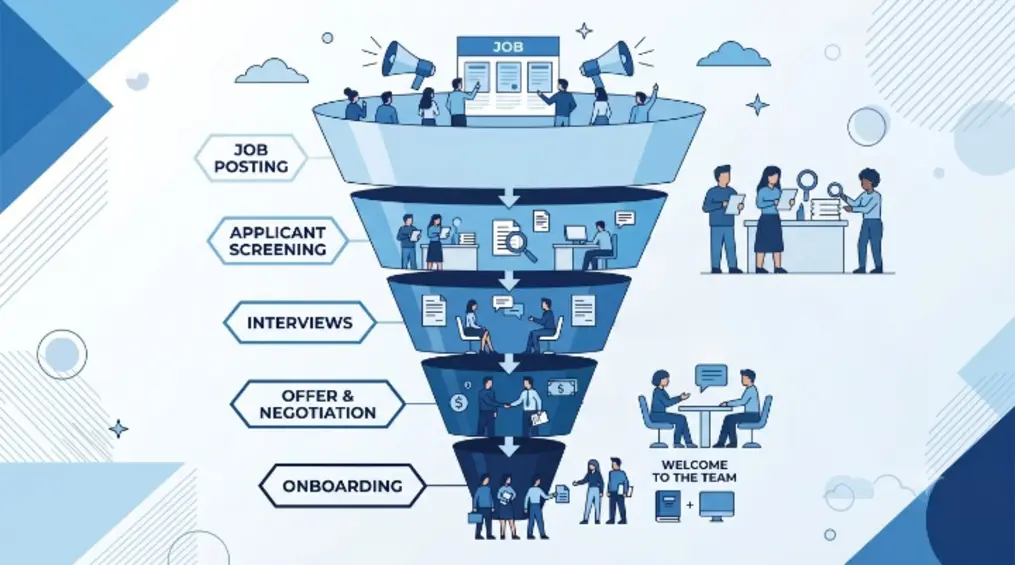
The 8-Step Recruitment Process
Step 1: Define the Hiring Need
Before writing a single line of a job description, answer these questions clearly:
- Is this a backfill or a newly created role?
- What specific gap does this hire address?
- What does success look like at 30, 60, and 90 days?
- Does this role genuinely need to be external, or can it be filled internally?
The most common mistake at this stage: HR launches recruitment without aligning with the line manager. Misaligned expectations between HR and hiring managers are among the top causes of failed hires and wasted interview cycles.
Step 2: Write a Compelling Job Description
Your job description is your first candidate touchpoint — and your most important sourcing asset on job boards. A weak JD produces weak applications.
An effective job description includes:
- Job title — clear, searchable, and free of internal jargon
- Role summary — 2 to 3 sentences explaining purpose and context
- Key responsibilities — 5 to 8 bullets, outcome-focused not task-listed
- Required qualifications — clearly distinguish must-haves from nice-to-haves
- Compensation range — salary transparency increases applications by up to 30%
- Company overview and culture — give candidates a reason to apply
Step 3: Choose the Right Sourcing Strategy
Posting on one job board and waiting is not a strategy. It’s a passive prayer.
Effective sourcing uses multiple channels simultaneously:
| Channel | Best Suited For |
| Professional, mid-to-senior, and technical roles | |
| Rozee.pk / Mustakbil | Pakistan-based white-collar and volume hiring |
| Employee Referrals | Culture-fit and trust-based hiring |
| Executive Search | Senior, confidential, or specialized mandates |
| Campus Recruitment | Fresh graduates and management trainee programs |
| Hicruit | End-to-end recruitment across industries in Pakistan |
Active sourcing of passive candidates — reaching employed professionals who aren’t actively job-hunting — consistently produces higher-quality hires. It requires skill, relationship-building, and a strong employer brand to execute well.
Step 4: Screen Applications Efficiently
Volume without structure creates noise. A systematic screening process filters for fit before anyone wastes time in an interview room.
Screening toolkit:
- Resume review — prioritize measurable achievements over generic responsibilities
- ATS filtering — automate initial screening by qualification keywords and criteria
- Phone screen — a 10 to 15 minute call to verify availability, salary expectations, and basic motivation before advancing a candidate
Common red flags (investigate, don’t automatically disqualify):
- Unexplained employment gaps
- Rapid job changes with no logical career narrative
- Generic CVs with zero role-specific customization
Step 5: Structure Your Interviews
This is where most hiring processes collapse into unreliable subjectivity.
An unstructured interview — where interviewers ask whatever comes to mind — has 14% predictive validity. A structured interview, where every candidate is asked the same predetermined questions and scored on the same criteria, raises that to 51%. That gap is the difference between guessing and deciding.
Interview types to combine for a complete picture:
| Interview Type | Purpose |
| HR/Screening Interview | Culture fit, motivation, career narrative |
| Competency-Based Interview | Evidence of past behaviour predicting future performance |
| Technical/Panel Interview | Role-specific skill and knowledge validation |
| Case Study or Assessment | Real-world problem-solving and judgment |
Best practice at Hicruit: HR conducts the first interview to assess fit and motivation. The hiring manager conducts the second to validate role-specific capability. This two-stage model balances objectivity with domain-specific insight — and keeps hiring managers focused on what they do best.
Step 6: Evaluate and Decide
Gut feel is not a selection methodology. Use a consistent evaluation framework across all interviewers.
Structured scorecard approach:
- Define your evaluation criteria before interviews begin — not after
- Rate all candidates on the same dimensions (skills, communication, culture fit, leadership potential)
- Hold a debrief meeting with all interviewers before making a decision
- Conduct reference checks — speak to at least two former supervisors
Sample decision matrix:
| Criteria | Weight | Candidate A | Candidate B |
| Technical Skills | 40% | 8/10 | 7/10 |
| Communication | 25% | 9/10 | 8/10 |
| Culture Fit | 20% | 7/10 | 9/10 |
| Leadership Potential | 15% | 8/10 | 7/10 |
| Weighted Score | 100% | 7.95 | 7.80 |
This removes recency bias, halo effects, and post-interview rationalisation from the process.
Step 7: Make the Offer — and Do It Right
A strong offer process is not just administrative. Done poorly, it loses candidates you’ve spent weeks finding.
Offer best practices:
- Make a verbal offer call first — before the written letter. It demonstrates respect and flags any issues early.
- Ensure the written offer letter clearly states: salary, benefits, start date, title, reporting line, and acceptance deadline
- Set a clear acceptance window — typically 3 to 5 business days
- Know your walk-away point before salary negotiations begin, not during them
Step 8: Onboard — Don’t Drop the Ball at the Finish Line
Recruitment doesn’t end at a signed offer letter. Poor onboarding is one of the leading reasons new hires disengage and leave within the first 90 days.
Onboarding essentials:
- Send a pre-boarding welcome email with Day 1 logistics and a checklist
- Assign a buddy or peer mentor for the first 30 days
- Set written 30/60/90-day goals in the first week
- Schedule weekly check-ins for the first month
The numbers back this up: organizations with structured onboarding programs improve new hire retention by 82% and productivity by over 70% (BambooHR, 2023).
Internal vs. External Recruitment: How to Choose
| Factor | Internal Recruitment | External Recruitment |
| Speed to Fill | Faster | Slower |
| Cost | Lower | Higher |
| Fresh Perspective | Limited | High |
| Skill Gap Coverage | Depends on talent pool | Strong |
| Team Morale Impact | Positive (if process is fair) | Neutral to mixed |
| Employer Brand Signal | Demonstrates growth culture | Signals ambition |
The right answer depends on role criticality, urgency, internal pipeline depth, and the specific skills required. Most mature organizations use both — deliberately.
5 Recruitment Mistakes That Kill Hiring Quality
- Vague job descriptions — produce irrelevant applications and waste screening time
- Skipping structured interviews — introduces unconscious bias and produces unreliable signals
- Moving too slowly — top candidates are off the market in an average of 10 days once active
- Ignoring employer brand — 75% of job seekers research a company before applying (Glassdoor); what they find matters
- No candidate feedback loop — ghosting candidates damages your pipeline, your brand, and your reviews on every public platform
Recruitment in Pakistan: What’s Different
Pakistan’s talent market has distinct dynamics that any serious recruiter must understand:
- Geographic concentration — the majority of skilled talent is clustered in Karachi, Lahore, and Islamabad. Remote-first policies are expanding access but adoption remains uneven.
- Salary transparency gap — candidates and employers often operate with very different market expectations. Platforms like Rozee.pk are shifting this, but benchmarking remains critical.
- Fresh graduate supply vs. skills gap — Pakistan produces large volumes of graduates annually, but skills gaps in technical roles, management, and soft skills remain significant.
- Employer branding is underdeveloped — most mid-market and SME employers in Pakistan have no structured employer value proposition. This is a genuine first-mover advantage for organizations willing to invest.
How Hicruit Can Help You Hire Better
Hicruit is Pakistan’s emerging end-to-end HR consulting and recruitment agency. We bring structure, speed, and expertise to every hiring engagement — whether you need to fill one critical role or build a scalable hiring function from scratch.
Ready to stop guessing and start hiring with precision?
Get in touch with Hicruit today — and let’s build your next team, the right way!